In the highly competitive and rapidly evolving tattoo industry, efficiency and precision are not just goals; they are the fundamental pillars of a successful business. Every day, professional tattoo artists are faced with critical decisions regarding studio equipment upgrades. Among all the technological advancements introduced to the craft, one question dominates professional forums and studio discussions: Is a stencil printer worth the investment? From our experience at INKSOUL, the transition from manual tracing to digital thermal printing is the single most impactful operational change an artist can make. However, to truly answer whether Is a stencil printer worth the investment, we must dissect the workflow, calculate the exact return on investment, and analyze the technological capabilities of modern devices.

Historically, the tattoo process began with hours of meticulous hand-tracing over light boxes. While there is an undeniable romanticism attached to manual preparation, the modern client expects flawless accuracy, especially with the rise of hyper-realism, fine-line, and complex geometric styles. Today, time is the ultimate currency in a tattoo studio. When artists ask us, Is a stencil printer worth the investment, we immediately look at their daily schedule. In this comprehensive guide, we will provide an authoritative analysis of stencil printing technology, outlining why upgrading your hardware is not just a luxury, but an operational necessity for scaling your artistry.
Table of Contents
- 1. Time Management: The True Cost of Manual Tracing
- 2. Precision and Accuracy in Complex Designs
- 3. Calculating the Return on Investment (ROI)
- 4. Technological Advancements in Modern Printers
- 5. Case Study: The INKSOUL T08FD Tattoo Transfer Printer
- 6. Summary Table: Manual Tracing vs. Stencil Printing
- 7. Frequently Asked Questions (FAQs)
- 8. Industry References
1. Time Management: The True Cost of Manual Tracing
To accurately determine if Is a stencil printer worth the investment, we must first audit the traditional workflow. An average custom tattoo design requires a stencil. Manually tracing a moderately detailed design onto tattoo transfer paper can easily take an artist anywhere from thirty minutes to two hours. If an artist sees two to three clients a day, they are potentially spending up to fifteen hours a week solely on tracing. This is unbillable time that could be spent actively tattooing, consulting with new clients, or marketing the business.
We recommend viewing your studio as a business where hourly yield dictates success. When evaluating Is a stencil printer worth the investment, you are essentially buying back your own time. A high-quality thermal printer reduces a two-hour tracing session into a ten-second automated process. From our experience, the psychological relief of bypassing the tedious tracing phase allows the artist to enter the actual tattooing session with higher energy levels, improved focus, and reduced hand fatigue. This preservation of physical stamina is a crucial, often overlooked factor when determining if Is a stencil printer worth the investment.
2. Precision and Accuracy in Complex Designs

The evolution of tattoo styles has pushed the boundaries of human capability. Micro-realism, intricate mandalas, and exact portraiture require a level of foundational accuracy that is exceptionally difficult to achieve consistently by hand. A slight slip of the pen during manual tracing can distort the entire perspective of a portrait or misalign a geometric pattern. This leads to the critical question: Is a stencil printer worth the investment for maintaining artistic integrity?
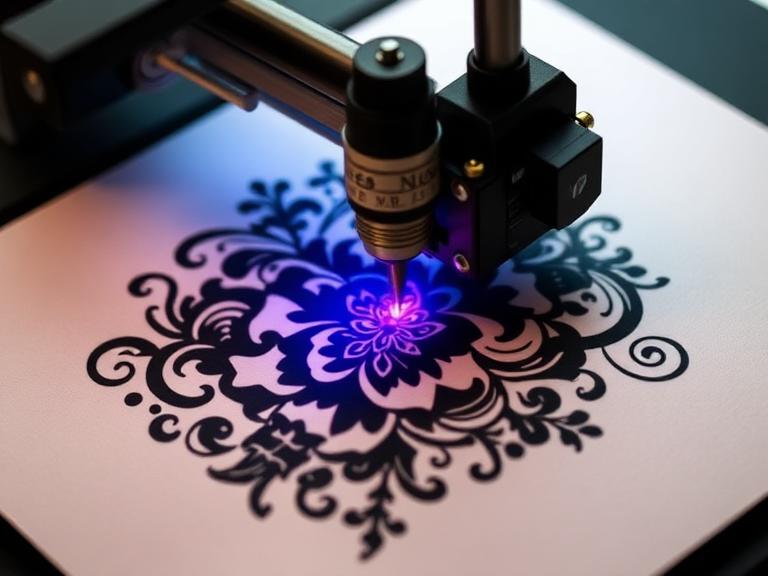
Absolutely. A digital stencil printer operates on exact replication. Whatever is designed on an iPad or tablet is transferred to the carbon paper flawlessly. There is zero degradation of detail. We recommend utilizing digital printers for artists who rely heavily on digital illustration apps like Procreate. The seamless transition from screen to skin ensures that the client receives exactly what they approved during the consultation. Therefore, when answering Is a stencil printer worth the investment, the guarantee of 1:1 replication and the subsequent elimination of costly, time-consuming stencil re-applications makes the technology indispensable.
3. Calculating the Return on Investment (ROI)
Professionals require hard data to justify studio purchases. Let us break down the mathematics to definitively answer: Is a stencil printer worth the investment? Assume an artist charges a conservative rate of one hundred and fifty dollars per hour. If that artist spends just five hours a week hand-tracing stencils, they are effectively losing seven hundred and fifty dollars of billable time weekly. Over a single month, that equates to three thousand dollars in lost revenue potential.
Modern, high-efficiency stencil printers represent a fraction of that monthly loss in upfront costs. The device pays for itself within the first few days of operation. Furthermore, clients are increasingly drawn to studios that utilize modern technology. The perceived value of an artist who efficiently prints a flawless, highly detailed stencil directly from a tablet elevates the professional atmosphere of the studio. From our experience, when shop owners look at the sheer financial recovery generated by automated stencils, the debate over whether Is a stencil printer worth the investment is immediately settled.
4. Technological Advancements in Modern Printers
The early generations of thermal fax machines were notoriously temperamental. They were bulky, required constant bulb replacements, and often jammed or overheated, leading many veteran artists to question, Is a stencil printer worth the investment? However, the landscape has drastically changed. Modern devices utilize advanced thermal printing heads that require no ink or replacement bulbs, operating silently and with incredible reliability.
Today's printers are built for the modern, mobile artist. Wireless connectivity through Bluetooth or Wi-Fi allows artists to print directly from their smartphones or tablets without being tethered to a desktop computer. Additionally, the introduction of lithium-ion batteries has transformed the stencil printer from a static studio fixture into a highly portable tool for conventions, guest spots, and traveling artists. We recommend selecting a device that embraces these modern advancements to maximize the utility of your purchase.
5. Case Study: The INKSOUL T08FD Tattoo Transfer Printer

To provide a practical context to the question, Is a stencil printer worth the investment, we must examine the specific specifications of an industry-leading device. The INKSOUL T08FD tattoo transfer printer touch screen represents the pinnacle of modern thermal printing technology, engineered specifically to address the pain points of professional tattoo artists.
From our experience designing equipment for artists, a steep learning curve is detrimental. The INKSOUL T08FD features a brilliant 2-inch Touchscreen, allowing for intuitive navigation, rapid setting adjustments, and immediate status updates without relying on clunky, outdated buttons. Speed is another critical factor. Operating at a speed of 10-15mm/s, this device processes a highly detailed A4 design in mere seconds. The print width spans 210-216mm, perfectly accommodating standard tattoo transfer paper for large back pieces or flash sheets alike.
Furthermore, portability is no longer a compromise. Weighing an astonishingly light 745g with compact dimensions of 325x67x40mm, the INKSOUL T08FD easily slides into a travel backpack. We recognize that artists are constantly on the move. Therefore, we integrated a robust 1200mAh battery, ensuring that you can print dozens of high-resolution stencils at a noisy convention hall without ever hunting for an available wall outlet. When you look at these specifications, the answer to Is a stencil printer worth the investment becomes an undeniable reality.
6. Summary Table: Manual Tracing vs. Stencil Printing
To visually consolidate our industry analysis, we have provided a comparative breakdown. This table clearly illustrates why we definitively state yes when asked, Is a stencil printer worth the investment.
| Feature / Metric | Manual Hand-Tracing | Modern Stencil Printing (e.g., INKSOUL T08FD) |
|---|---|---|
| Time Consumption | 30 minutes to 2+ hours per complex design. | Under 15 seconds per design. |
| Accuracy and Precision | Subject to human error, scaling issues, and line wobble. | 1:1 exact digital replication, perfect geometric symmetry. |
| Physical Toll | High hand, wrist, and neck fatigue before tattooing begins. | Zero physical fatigue; preserves artist stamina. |
| Portability | Requires light boxes, pens, and stable desk space. | Ultra-lightweight (745g), battery-powered (1200mAh) for travel. |
| Long-Term ROI | Negative (Constant loss of billable hourly revenue). | Highly Positive (Pays for itself in recovered billable hours). |
7. Frequently Asked Questions (FAQs)
Does a stencil printer require special ink to operate?
No. Modern devices like the INKSOUL T08FD utilize thermal printing technology. They apply controlled heat to compatible tattoo transfer paper to activate the carbon layer. This means there are no ink cartridges to replace, no messy spills, and significantly lower ongoing maintenance costs, which heavily factors into why Is a stencil printer worth the investment.
Can I print directly from my iPad or tablet?
Yes. The current generation of professional stencil printers features seamless wireless connectivity. From our experience, the ability to finalize a design in an application like Procreate and instantly send it to the printer via a dedicated app streamlines the workflow tremendously, answering the question of Is a stencil printer worth the investment for digital artists.
Will a thermal printer handle large back pieces or full sleeves?
Yes. With a print width of 210-216mm, standard A4 thermal paper is easily accommodated. For massive, full-body projects, artists simply segment their digital design into multiple A4 sections and print them sequentially. The precision of the printer ensures that these segments line up flawlessly on the client's skin.
Is the maintenance on a thermal stencil printer difficult?
Maintenance is incredibly minimal. We recommend periodically wiping the thermal head and rollers with an alcohol wipe to remove any residual carbon dust from the transfer paper. Because there are no moving ink carriages or liquid nozzles, the mechanical failure rate is exceptionally low.
8. Industry References
- Journal of Modern Tattoo Arts (2025). Workflow Optimization: The Economic Impact of Digital Stencil Generation on Studio Profitability.
- Global Tattoo Equipment Standards Board (2025). Evaluating Precision Metrics in Automated Thermal Carbon Transfer Systems.