If you've been shopping for a tattoo pen lately, you've probably noticed something strange: search results are drowning in cheap Amazon kits with zero buying advice, while the one detailed guide everyone links to doesn't actually sell anything — it just sends you to Amazon. That's the gap this guide fills.

A rotary tattoo pen is the single most important tool you'll buy as an artist. It's the machine that lives in your hand for six, eight, ten hours a day. The right one feels like an extension of your fingers: quiet, balanced, predictable, and consistent from the first line of the day to the last whip-shade of the night. The wrong one fights you — overheats mid-session, spits inconsistent lines, wobbles on color packing, and turns every piece into a battle with the tool instead of the art.
This guide walks you through everything that actually matters when choosing a tattoo pen machine: how rotary pens work, wireless vs. wired, how to pick the right stroke length and motor, what beginners and experienced artists should buy differently, and — something almost no other guide will tell you — how to spot a genuine machine from a white-label copy, a refurbished unit sold as new, or grey-market stock with no warranty behind it. We've written it as an authorized dealer of Dragonhawk, MAST, EZ, BigWasp, Bronc, and Ambition: the brands' biggest names actually trust us with, the same machines sitting in our own warehouse, backed by our service.
So whether you're buying your first pen or upgrading your third, you'll finish this guide knowing exactly what to look for — and where to get the real thing. Ready when you are: browse the full lineup in our tattoo pen machine collection.
How a Rotary Tattoo Pen Actually Works (And Why It Matters)
Every tattoo pen on the market today is a rotary machine — meaning a small electric motor drives the needle up and down in a straight-line motion. That's it. No springs, no coils, no tuning screws. You plug it in (or charge it), set your voltage, and tattoo.
Inside the pen, the motor spins an eccentric cam or an offset bearing. That rotation is converted into the needle's vertical travel — typically 25 to 140 pushes per second, depending on your voltage. The needle never stops; it just punches in and out at a constant rate while you move your hand to draw lines, pack color, or whip shading. The motor's job is simple: keep that motion smooth and constant no matter how much resistance the skin gives back.
That last part is the whole game. A weak or poorly balanced motor bogs down when you push into thicker skin — the needle slows, the hit gets inconsistent, and you get scratchy lines and patchy color. A good motor holds its speed under load, which is why two pens with the same voltage setting can feel completely different in your hand.
Why does the mechanism matter for your buying decision? Because rotary pens differ in exactly three variables that change how that motor motion reaches your needle:
- Direct drive vs. cam systems — In a direct-drive pen, the motor pushes the needle bar straight down with a nearly linear motion. It's efficient and punchy, excellent for lining and hard color packing. In a cam or slider system, a rotating cam moves a follower that drives the needle — this often produces a slightly softer, more forgiving hit. Neither is "better" universally; hard-hitters suit bold traditional work, softer hits suit black-and-grey and realism where you want gentle layering.
- Adjustable vs. fixed stroke — The stroke (covered in detail below) is how far the needle travels. Some pens let you swap cams or twist a dial to change stroke; others are fixed. Adjustable-stroke pens cost more but replace two or three single-stroke machines in your kit.
- Brushless vs. brushed motors — Traditional brushed motors are cheap and proven but wear out and run hotter; brushless motors run cooler, quieter, longer, and hold voltage better under load. In 2026, most serious pens from the big brands have moved to brushless designs.
Here's the buyer's translation: when a listing says "direct drive, brushless motor, adjustable stroke," it's describing a versatile, modern pen. When a listing says nothing about the motor at all — red flag. Reputable brands like MAST, Dragonhawk, and Ambition publish motor specifications because they have nothing to hide; white-label sellers stay vague because their specs change with every production batch.
Wireless vs. Wired: The Real Trade-Offs
Let's get this out of the way first: in 2026, wireless is the default for most working artists, and it's not close. But "wireless is better" needs a qualifier — because not all wireless is equal, and wired still has its place.
The case for wireless. Freedom of movement is the obvious win — no cord dragging across your client's arm, no cord getting caught on the tray, no clip cord to bag and re-bag between sessions. Setup and breakdown get faster. For guest spots and conventions, wireless isn't just nice; it's practically mandatory. Modern battery packs from the big brands deliver consistent voltage until they die, charge over USB-C, and many are swappable mid-session so you never actually stop working. A typical workday of 4–6 hours is well within reach of two battery packs on rotation.
The case for wired. A wired pen is lighter (no battery pack hanging off the back), cheaper for the same motor quality, and never dies mid-line. If you work a fixed station, tattoo long sessions, and don't travel, a wired pen plus a good power supply gives you the best performance per dollar — full stop. Some artists also prefer the lighter balance of a wired pen for fine detail work.
What actually goes wrong with cheap wireless. This is where buying decisions get expensive. Budget wireless pens cut corners exactly where it hurts most: batteries that sag in voltage as they drain (your lines get weaker through the day and you don't notice until you see the healed result), charge ports that loosen after a few months, and battery packs that die at 40% of their rated capacity after a year. The battery is the most failure-prone part of any wireless pen — which is why it matters enormously whether your seller can actually replace it. An authorized dealer stocks replacement battery packs and honors the warranty; a marketplace seller is gone by the time your battery degrades.
The decision rule: if you travel, do guest spots, or work conventions → go wireless from a brand with replaceable battery packs. If you work a fixed station and want maximum performance per dollar → a wired pen is the smart buy. Either way, don't buy wireless from a brand that can't sell you a spare battery — that pen has a built-in expiration date. We go much deeper on batteries, charging, and voltage stability in our wireless tattoo pen guide.
Stroke, Power, and Motor: How to Match the Specs to Your Style
This is the section that separates a good purchase from a lucky one. Three specs determine how a pen behaves on skin, and every brand expresses them slightly differently — so let's decode them.

Stroke length: the single most important spec
Stroke is how far the needle travels from its highest to lowest point, measured in millimeters. Common options: 3.0, 3.5, 4.0, 4.2, and 5.0 mm. Think of stroke as the pen's personality:
- Short stroke (3.0–3.5 mm): softer hit, less skin trauma, needle stays in the skin longer per cycle. The go-to for black-and-grey, whip shading, pepper shading, and realism — anywhere you want gentle, buildable layers. Most all-rounder artists live at 3.5 mm.
- Medium stroke (4.0 mm): the versatile middle. Punches color in efficiently without beating up the skin. If you only own one pen and do a bit of everything, this is the stroke.
- Long stroke (4.2–5.0 mm): hard, fast hit. Built for bold lining, traditional work, and solid color packing where you need the needle to drive pigment deep in fewer passes. Hits harder, which means more trauma if your hand is heavy — this stroke rewards experience.
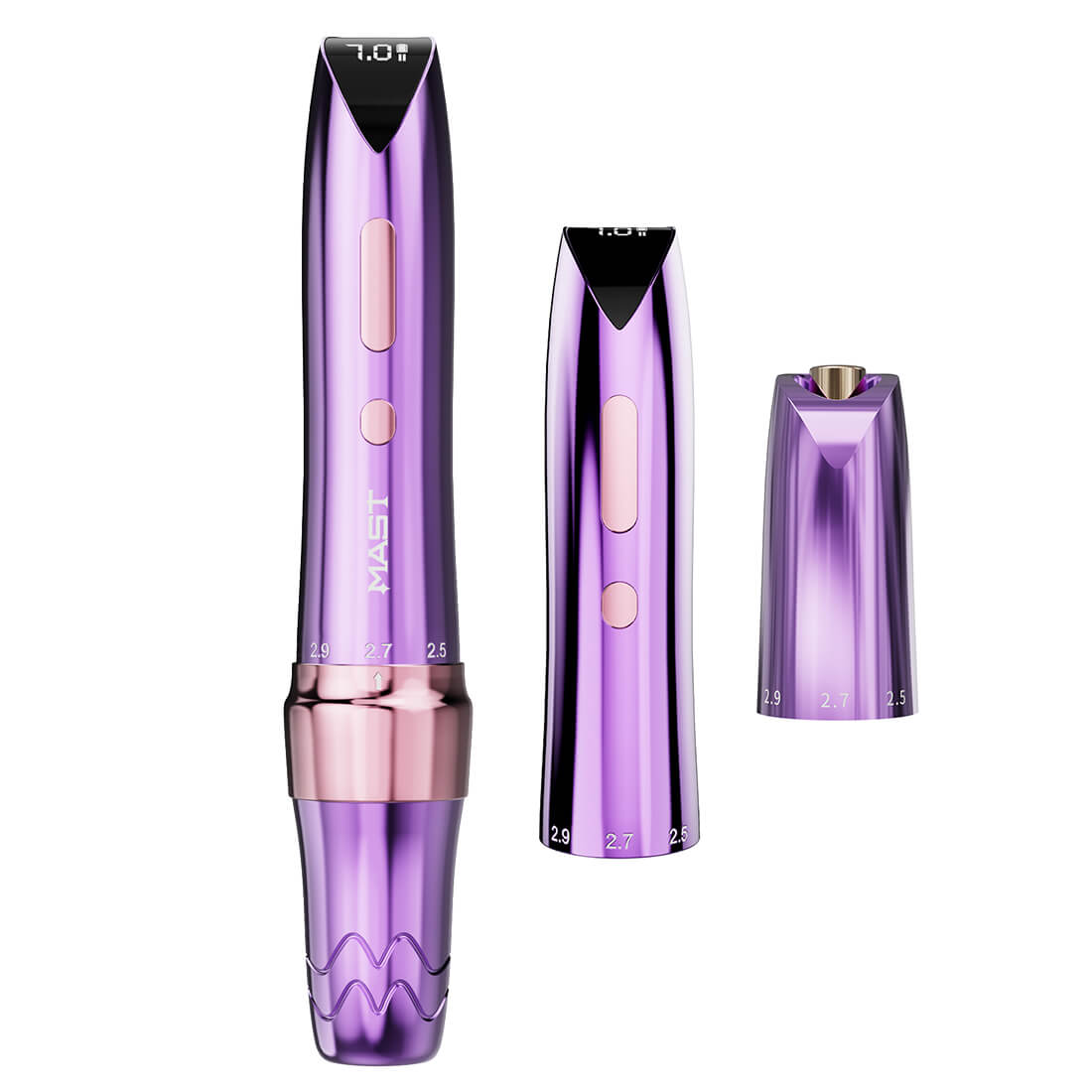
Brands' flagship pens increasingly ship with adjustable or interchangeable stroke systems — twist a dial or swap a cam and the same pen goes from 3.5 to 4.2 mm. That's genuinely useful: one pen, two personalities, and you stop carrying a second machine "just in case." If your budget allows one pen only, adjustable stroke is the feature worth paying for.
Voltage and "power": what the numbers actually mean
Voltage (typically 4–12 V) controls needle speed: higher voltage, faster hits. But voltage alone tells you almost nothing about power — what matters is whether the motor *holds* that speed when the needle meets skin resistance. A strong motor at 7 V outperforms a weak motor at 9 V, every time.
Practical voltage ranges by task: lining usually runs higher (7.5–9 V), shading lower (6–7.5 V), color packing in the middle — but these are starting points, not rules. Your hand speed, needle grouping, and skin type shift everything. The useful buying signal isn't the voltage range on the box; it's the motor's reputation. This is exactly where dealer knowledge beats spec sheets: we see which motors come back for service and which ones never do.
Motor type and eGive (electronic hit adjustment)
Two motor notes for 2026 buyers. First, brushless motors are now the standard in serious pens — cooler, quieter, longer-lived, and they hold voltage under load better than brushed designs. If a pen in the $150+ range still uses a brushed motor, you're paying 2026 money for 2019 tech.
Second, many flagship pens now include eGive — electronic adjustment of the needle's "give" (how much the hit softens on contact). It mimics the spring-loaded feel of old coil machines digitally. Nice to have, not a must-have: if you learned on coils and miss that forgiving hit, eGive is your bridge. If you learned on rotaries, you'll barely touch it.
The cheat sheet: beginner doing a bit of everything → 3.5–4.0 mm stroke, brushless motor, reputable brand. Black-and-grey/realism specialist → 3.0–3.5 mm, softer hit system. Bold traditional/color packer → 4.0–5.0 mm, direct drive. One-pen owner → adjustable stroke.
Beginner vs. Experienced: Buy for Where You Are, Not Where You Wish You Were
The most common buying mistake in tattoo pens isn't buying cheap — it's buying *wrong for your level*.
If you're starting out, your priorities are forgiveness, simplicity, and not going broke before your first paying client. You want a mid-range pen from a real brand — not the cheapest kit on the internet, and not a $400 flagship whose subtleties you can't feel yet. A 3.5 or 4.0 mm stroke covers lining practice and basic shading; wireless is worth it if you can stretch, because you'll be moving around a lot while learning positioning. What you don't need yet: adjustable stroke you'll never adjust, eGive settings you'll never touch, and a second pen "for color" when you're still learning to pull a straight line. One solid, honest pen beats a bag of gimmicks.
Just as important: buy from somewhere that answers questions. Beginners break things, misread manuals, and need a battery replaced at the worst moment. An authorized dealer with real support is worth more to a beginner than any spec upgrade.
If you're experienced and upgrading, you already know your stroke, your voltage habits, and what your current pen can't do. Your upgrade checklist: what's the specific limitation? (Overheating on long sessions? Inconsistent hit on color packing? Cord in the way at conventions?) Buy the pen that fixes *that*, with the stroke system matched to your dominant style. This is also the level where a second pen earns its keep — a dedicated liner at 4.0+ mm and a dedicated shader at 3.5 mm, instead of one pen constantly re-adjusted mid-session.
The apprentice trap to avoid: buying a pro flagship as your first pen "to grow into." Flagship pens assume your hand already knows what it's doing — their power and speed punish heavy hands with blowouts and overworked skin. A forgiving mid-range pen teaches you control; the flagship rewards control you already have. Grow into the flagship with your second purchase, not your first.
How to Spot a Genuine Machine (And Why It Matters More Than the Price)
Here's the section other guides won't write, because they're not the ones answering the warranty emails.
The tattoo pen market has a counterfeit and grey-market problem. The same popular designs — especially from MAST, Dragonhawk, and Ambition — get copied relentlessly. And the copies aren't just "a cheaper version of the same thing." Here's what we actually see come through service channels:
- White-label copies: same shell shape, different guts. The motor is whatever was cheapest that month, the battery (if wireless) is unbranded, and the stroke marking on the box may not match what's inside. They look right in photos and feel wrong in your hand within a week.
- Refurbished units sold as new: returned pens, wiped down, resealed, sold at "too good to be true" prices. The motor already has hundreds of hours on it. You find out when it dies in month two.
- Grey-market stock: genuine machines, but imported through unofficial channels. They work fine — until they don't. No warranty, no spare parts, no firmware support, and the brand won't touch them because the serial number isn't in their dealer system.
How to protect yourself — the checks that actually work:
- Buy from an authorized dealer. Brands publish dealer lists for a reason. If the seller isn't on it, you're gambling. (We are an authorized dealer of Dragonhawk, MAST, EZ, BigWasp, Bronc, and Ambition — the brands verify it, not us.)
- Check the serial number. Genuine pens from the major brands carry verifiable serial numbers. Ask the seller for it before you buy; check it with the brand if you're unsure.
- Price-check against reality. If a $200 pen is selling for $89 "brand new," it's not a deal — it's one of the three categories above. Nobody sells genuine stock below cost out of kindness.
- Look for parts and service. A legitimate seller stocks replacement batteries, motors, and stroke cams, and tells you the warranty terms up front. If the listing can't answer "what happens when the battery dies," walk away.
- Inspect on arrival. Genuine packaging is consistent: clean printing, correct logos, matching serial numbers on box and machine, proper manuals. Sloppy packaging on a "premium" pen is the oldest tell in the book.
This isn't scare tactics — it's the economics of the business we're in. We sell these machines every day, we service them, and we see the aftermath when artists buy "the same pen" from a random listing. The price difference between genuine and grey is almost always smaller than the cost of one ruined session.
A Note on That Other Buying Guide
If you've been researching tattoo pens, you've probably landed on the currently top-ranking guide — a September 2026 roundup that tests eight rotary machines and links every "check price" button to Amazon. It's a decent read, and credit where it's due: the author did real hands-on testing, and the spec tables are genuinely useful.
But it's worth understanding what that site is. It's an affiliate publisher — a middleman. It doesn't stock the machines, has never serviced one, can't sell you a replacement battery, and won't answer the phone when your motor dies mid-convention. Every click flows to Amazon, where you're buying from whichever third-party seller won the buy box that day — with all the counterfeit, refurbished, and grey-market risk described above, and no specialist support behind the sale.
Here's the part that matters for your wallet: four of that guide's top picks are MAST, Dragonhawk, and Ambition machines — the exact brands we are authorized to sell. Same machines, same manufacturers. The difference is what comes with the box: genuine stock with verifiable serial numbers, manufacturer warranty honored through an authorized dealer, replacement parts on the shelf, and people who actually tattoo-supply for a living answering your questions.
We're not saying don't read affiliate reviews — read them, compare the specs, use their testing. Then buy the machine from someone accountable for it after the sale. That's us.

Our Recommendations: Authorized Brands, Honest Picks
We only recommend what we sell and service — machines from the brands we're authorized to deal, sitting in our warehouse, with parts and warranty behind them. No sponsored placements; if a brand's pen isn't right for a category, we say so by omission. Prices are from our store at the time of writing — check the collection page for current pricing.
Our Pick: INKSOUL HV6 PRO — This is the pen we put our own name on, and it's our first recommendation. The HV6 PRO is INKSOUL's own flagship pen — the machine we'd hand you if you asked us to pick one for all-day professional work.
Best all-rounder (wireless): MAST wireless pen series — MAST's wireless pens are the ones we see most in working studios, and there's a reason: consistent voltage delivery, swappable battery packs, and a motor lineup that covers lining through shading. If you own one pen and do a bit of everything, start here — the Mast Archer S wireless tattoo pen is a proven example of the series.
Best for bold traditional & color packing: Bronc pen series — Bronc's pens are built for the harder hit that bold traditional lining and large-scale color packing demand. The value proposition is simple — pro-level hit without the flagship price tag — and the Bronc Siren adjustable wireless pen is a solid example.
Best value pick: EZ P3 series — For the artist who wants maximum performance per dollar, EZ's P3 Pro wireless pen delivers an honest motor and solid build at a price that leaves room in the budget for needles and ink.
We also carry Dragonhawk and Ambition as an authorized dealer — both solid machines worth comparing if you already know their feel.
Beginner pick: any of the above in 3.5–4.0 mm, wired if budget is tight — The brand matters less than the buying channel at this level: get a genuine machine from an authorized dealer, in a forgiving mid stroke, and spend the savings on practice skin and needles. Your second pen — the one matched to your style — comes after your first hundred hours.
What we deliberately don't do here: rank these 1-to-5 as if tattooing had a single "best." A black-and-grey artist and a traditional artist need opposite machines. The honest recommendation is the one matched to your style, your level, and your working reality — which is exactly what the sections above were for.
Frequently Asked Questions
How much should I spend on a tattoo pen?
For a genuine machine from a major brand, expect roughly $100–$250 for a solid mid-range pen and $250+ for flagships with adjustable stroke and premium motors. Below $100 "brand new" for a name-brand pen, you're almost certainly looking at a copy, a refurb, or grey stock. A beginner's honest budget: one genuine mid-range pen, not three suspiciously cheap ones.
Can I use any cartridge needles with any pen?
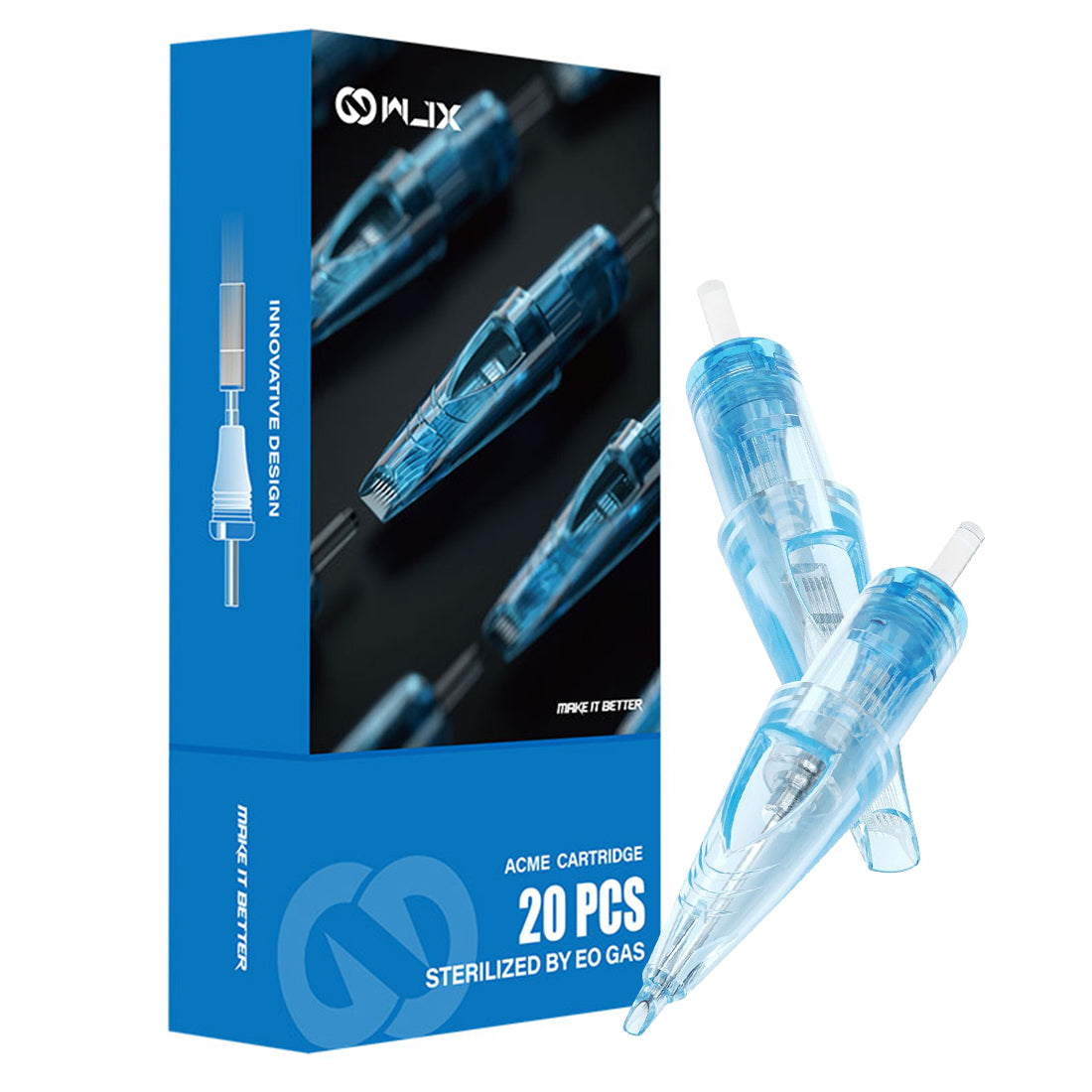
Most modern pens use the standard cartridge system and accept cartridges from any reputable needle brand. Our cartridge needle buying guide breaks down every configuration. The exceptions are rare proprietary systems — check before you buy, not after. When in doubt, ask the dealer (that's us) which cartridges pair with the pen you're eyeing.
How long does a wireless pen battery last?
It depends on voltage, needle grouping, and how hard you run it — but from the big brands, a full charge typically covers a standard session, and swappable packs mean you rotate instead of stopping. The honest answer for any specific model is in its listing; the buying rule is the one from the wireless section: if the seller can't sell you a spare battery, don't buy the pen.
Do I need an adjustable-stroke pen?
Need it? No. Want it if you only own one pen? Yes. Adjustable stroke (typically 3.5–4.2 mm on flagship models) lets one machine cover lining and shading credibly. If you own two pens — a liner and a shader — fixed strokes matched to each job are simpler and often cheaper.
How do I know my pen is genuine?
Buy from an authorized dealer, check the serial number with the brand, and inspect the packaging on arrival. The full checklist is in the genuine-machine section above. If you bought from us, the serial is verifiable and the warranty is honored — that's the entire point of buying from a dealer.
Coil vs. rotary — should I care in 2026?
For pen buyers, no. Rotary pens won this war years ago; coil machines are now a specialty/niche choice. If you miss the coil feel, look at pens with eGive (electronic give adjustment) — it emulates that forgiving hit digitally. Don't buy a coil machine as your first machine in 2026.
The Bottom Line
A tattoo pen is a working tool, not a trophy. Buy the stroke that matches your style, the motor from a brand that publishes its specs, and the machine from a seller who's still there when you need a battery in eighteen months. Read the affiliate guides for their testing — then buy from the dealer.
Our lineup is the brands the guides themselves keep recommending — MAST, Dragonhawk, Ambition, EZ, Bronc, BigWasp — as an authorized dealer, with genuine stock, verifiable serials, and real after-sales support. Browse our tattoo pen collection for everything above, and if you're torn between two machines, ask us — matching artists to pens is literally what we do all day.