
Nouvelles
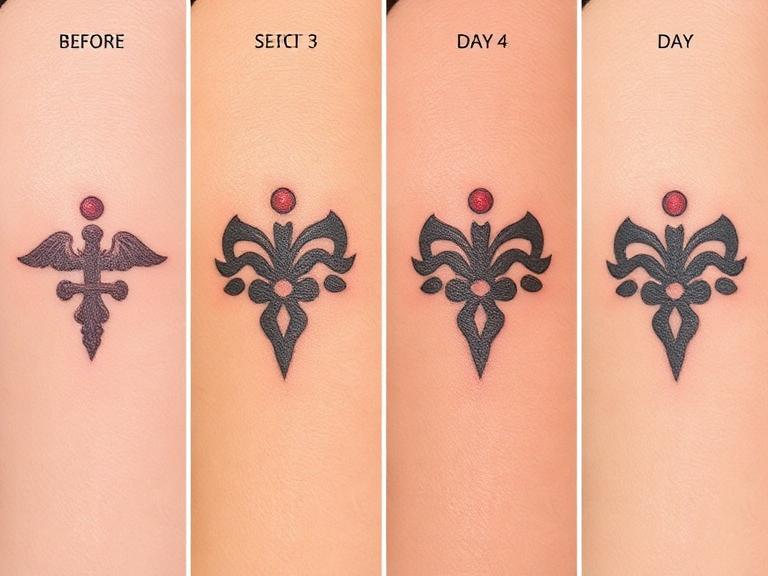
aftercare
What Are the Stages of Tattoo Healing? A Day-by-Day Guide
A tattoo heals in five stages over 2–4 weeks on the surface and 3–6 months underneath: weeping and swelling (days 1–3), scabbing and itching (days 4–7), peeling (days 7–14), a cloudy "milky" phase (days 15–30), then invisible deep healing. Most mid-way scares — flaking, dullness, itch — are normal; the real exceptions are few and listed below.
Your artist's written aftercare instructions come first. This guide explains what is happening under the skin so you can tell whether what you see is normal — it does not replace your artist's advice or a doctor's.
Tattoo Healing Stages at a Glance
Stage
When
What you will see
What matters most
1. Open wound
Days 1–3
Redness, swelling, plasma weeping
Keep it covered, wash gently
2. Scabbing and itching
Days 4–7
Thin scabs, tight skin, itching
Do not scratch or pick
3. Peeling
Days 7–14
Flaking like sunburn, dull color
Let flakes fall on their own
4. Milky phase
Days 15–30
Cloudy, faded look, silver skin
Do not judge color yet
5. Deep healing
Months 1–6
Nothing visible; ink settles
Sunscreen from here on
Stage 1 — Days 1–3: Weeping, Swelling, and the Open Wound
A fresh tattoo is an open wound, and the first three days are the inflammatory phase: your immune system responding to thousands of tiny punctures. Expect redness, mild swelling, warmth, and tenderness. A clear fluid — plasma, sometimes mixed with a little blood and excess ink — will weep from the tattoo, especially in the first 24 hours. That fluid is supposed to be there: the ink in it is excess your skin never held, not your tattoo washing out. Under film, that fluid can pool into a dark, squishy bubble — an “ink sac.” It looks alarming and is normal: plasma and excess ink, not your tattoo melting.
What matters most is what covers the tattoo — "bandage" means three different things with three different wear times:
Adhesive second-skin film (transparent film stuck directly to the skin, Saniderm-style): the one that stays on for days. Most studios use two pieces: the first for 8–24 hours while the tattoo weeps, then a fresh piece for 3–5 days once the skin is calm and dry. The step people skip is the drying — pat dry, then air-dry 20–30 minutes before the second piece goes on, or it will not stick. Hard ceiling: about 7 days total.
Plain cling film taped around the tattoo: 2–4 hours, then remove it and wash. Never overnight — past four hours it traps heat and moisture and helps bacteria, not you.
Self-adherent cohesive wrap (stretchy "vet wrap"): a trip-home wrap for the first day only.
If your film leaks or lifts on day one, do not keep a compromised piece on because you think the tattoo "has to" stay wrapped for five days — switching early to wash-and-moisturize is completely fine. To remove film, peel it slowly under warm running water in the shower, pulling parallel to the skin — never rip it off dry. If your artist only applied the first wrap, keep spare second-skin film sheets at home — the second piece is a fresh sheet, not a reuse. For the full wear-time logic, see our guide on how long a tattoo aftercare bandage should stay on.
Wash twice a day with lukewarm water and mild, fragrance-free soap — hands first, fingertips only — then pat dry. Apply only a thin layer of aftercare cream; a thick coat traps moisture.
Stage 2 — Days 4–7: Scabbing and the First Itch
By day four the weeping has mostly stopped. Thin, light scabs form, the skin feels tight and dry, and the itching begins. Thin scabs are normal; thick, raised ones usually mean the skin was overworked, or a scab got picked and re-formed thicker. A thin scab falling off alone costs nothing; a thick scab torn off early can take ink with it — the main way ink is lost during healing.
Wash and moisturize twice a day; wear loose clothing so fabric does not drag the scabs. Do not scratch — slap the skin lightly through clothing instead. No soaking until the surface is closed: showers fine, baths, pools, hot tubs, saunas not.
First-week life rules: skip heavy workouts for 2–3 days — sweat and stretching pull at scabs, and gym equipment is a bacteria source on an open wound. Sleep on clean sheets, not on the tattoo; if bedding sticks in the morning, soak it loose with lukewarm water, never rip. Keep pets off the bed and away from the tattoo while it is still an open wound.
Stage 3 — Days 7–14: Peeling (Like a Sunburn)
This stage worries first-timers most, and it is the most harmless one. The tattoo peels in flakes, much like a sunburn, and the flakes are often colored — dead skin carrying pigment, not your tattoo coming off. Let every flake fall on its own: pulling one that is still attached pulls the scab it is anchored to, the same ink-loss mechanism as stage 2.
Colors look dull — the flaking top layer scattering light, not fading ink. Two thin applications a day is enough; more keeps the surface soggy.
Stage 4 — Days 15–30: The Milky Phase — Why Your Tattoo Looks Faded
By week three the flakes and scabs are gone, but the tattoo still looks unfinished — cloudy, dull, or covered in a thin shiny layer artists call "silver skin" (the milky phase). That is the new epidermis, still cloudy while it matures, sitting between your eye and the ink below. The color is not gone; it returns as that layer clears, usually within one to two weeks.
Do not judge the final color now, and do not book a touch-up now — a touch-up can only be judged once the surface has settled, and most artists will not assess one before 6–8 weeks. If a patch still looks light after eight weeks, talk to your artist then. Sun protection starts now: loose clothing is the only protection while the skin is still closing; sunscreen (SPF 30+) only once the surface is fully intact. UV is the fastest way to fade a healed tattoo.
Stage 5 — Months 1–6: Deep Healing You Can't See
After a month the surface looks done. Underneath, it is not: the dermis — where the ink actually sits — keeps rebuilding for 3–6 months. You cannot see it happening, which is why it gets ignored: the tattoo looks finished, so people stop protecting it and wonder why a line softened by month three.
Nothing special is required beyond habit: daily sunscreen and normal moisturizing. What changes is your judgment — the result at month two or three is the real one. If a line blurred, talk touch-up then, not at week two, when the milky phase was still lying to you.
What Makes Healing Faster or Slower
Healing time is not one number:
Size and density. A small line-work piece can look settled in 10–14 days; a large blackwork piece can take the full four weeks.
Placement. Hands, feet, elbows, and knees heal slowest — they move constantly and get knocked. Expect 4–8 weeks on these spots, not two.
Aftercare Checklist That Actually Matters
Almost all of the value is in five habits:
Wash twice a day with lukewarm water and fragrance-free soap, fingertips only, pat dry with a clean paper towel.
Moisturize thin. A thin layer of a dedicated tattoo repair cream, twice a day — breathable, not a heavy petroleum ointment caked on thick. If the skin looks shiny, you used too much.
Keep the film protocol straight. Second-skin film is a two-piece process (8–24 hours, then 3–5 days); cling film is 2–4 hours. For large work, the 6-inch roll is the better buy.
No soaking, no sun. Showers only until the surface is closed; sunscreen once healed.
Hands off. No scratching, picking, or peeling — slap lightly through clothing if it itches.
Normal vs. Red Flag: When to Call Your Artist (or a Doctor)
What you notice
Normal if…
Get it checked if…
Redness
Confined to the tattoo, fading after 2–3 days
Spreading beyond the outline, or worse after 48 hours
Swelling
Mild, easing daily
Growing after 48 hours, or hot and tight
Itching
Comes and goes from day 4
A rash spreads past the edge
Redness in the shape of the film
—
Usually an adhesive reaction — see our film-redness guide
Discharge
Clear plasma in the first 1–2 days
Thick yellow/green pus, foul smell, red streaks
Pain
Soreness easing daily
Climbing after day 3, or fever above 38.3°C / 101°F
Scabs
Thin, dry, falling off alone
A scab lifts while still wet underneath
Fever, spreading redness, pus, red streaks, or climbing pain are not "part of healing." Call your artist first — one photo tells them whether it is normal — and see a doctor promptly if it is worse.
FAQ
How long does a tattoo take to heal completely?
The surface heals in 2–4 weeks; the deeper dermis keeps settling for 3–6 months. Small tattoos can look settled in 10–14 days; hands, feet, and joints can take 4–8 weeks. Judge the result at two months, not week two.
Is it normal for my tattoo to look faded after it peels?
Yes. After peeling, the new epidermis is still cloudy — the milky or silver-skin phase — between your eye and the ink. The color looks dull for one to two weeks, then comes back into focus as that layer clears. Do not judge the color or book a touch-up during this phase.
Can I shower or swim while my tattoo is healing?
Showers are fine from day one: brief, lukewarm, pat dry after. Do not soak — no baths, pools, hot tubs, or saunas — until the surface is fully closed, usually week 3–4. Soaking softens scabs before they are ready to fall — one of the easiest ways to lose ink.
When can I book a touch-up?
Most artists will not assess a touch-up before 6–8 weeks — the honest point is closer to two months, once the milky phase has cleared. Booking earlier means judging a tattoo still changing. If a patch still looks light after eight weeks, talk to your artist then.
Is itching normal, and when is it a problem?
Itching from about day 4 is normal — the surface is closing and the skin is drying out. It is a problem if a rash spreads past the tattoo's edge, if skin breaks open from scratching, or if itching comes with spreading redness, heat, or fever. Do not scratch; slap lightly through clothing instead.