In the professional tattoo industry, one of the most persistent requests we receive from indecisive clients is a demand for a temporary tattoo for 6 months. Consumers are heavily marketed to by social media startups promising "made-to-fade" ink that looks completely authentic for half a year and then vanishes without a trace. From our experience at INKSOUL®, supplying professional artists and studios globally, we must set the record straight: the biology of human skin does not support a perfectly fading six-month tattoo. You are being sold a biochemical impossibility.

When clients ask for a temporary tattoo for 6 months, they are usually trying to test-drive a large piece of art before committing to a lifetime of ink. We respect that caution. However, in most professional situations, the commercially available "fading" tattoos either disappear unevenly, leaving you looking like you have a severe skin condition for two years, or they disappear completely within two weeks. If you want to make an informed, practical decision about your body, you need to understand the mechanics of the epidermis versus the dermis. In this comprehensive industry guide, we break down why the six-month mark is a biological dead zone, how fading inks actually work, and the professional methods you should use instead to test your tattoo ideas.
Quick Answer: Can You Get a Temporary Tattoo for 6 Months?
No, there is no reliable method to get a temporary tattoo for 6 months that maintains a high-quality appearance and fades cleanly. Here is the biological reality:
- Surface Tattoos (Henna/Jagua/Stickers): These sit on the epidermis. Because your skin completely regenerates its outer layer every 28 days, these will never last 6 months. They max out at 1 to 3 weeks.
- "Made-to-Fade" Ephemeral Inks: These are injected into the dermis using real tattoo machines. While they are marketed to fade in 9-15 months, our industry observation shows they fade highly unpredictably. Many clients are left with patchy, blown-out remnants that last over two years.
We recommend bypassing gimmicky fading inks completely. If you want to test a design, use professional stencil transfer paper to wear the exact design for a few days. If you love it, commit to permanent ink.
Table of Contents
- What It Is: The Myth of the 6-Month Tattoo
- How It Works: Skin Biology & Ink Retention
- Benefits of Testing Tattoo Designs
- Limitations of Fading Ink Formulations
- Who Should Use Temporary Alternatives
- Who Does Not Need Fading Tattoos
- Common Mistakes Clients Make
- Commercial Buying Considerations
- Comparison Table: Tattoo Durations
- Pros and Cons of Made-to-Fade Ink
- Expert Recommendation & Stencil Solution
- Frequently Asked Questions
What It Is: The Myth of the 6-Month Tattoo

When consumers search for a temporary tattoo for 6 months, they are looking for a Goldilocks solution: something tough enough to withstand daily showers, sunlight, and friction, yet chemically programmed to dissolve harmlessly into the bloodstream exactly 180 days later. This product does not exist. The temporary tattoo market is rigidly divided into two categories: topical stains and dermal implants.
Topical stains include water-slide decals (childhood temporary tattoos), Henna, and Jagua gel. These sink into the very top layer of dead skin cells (the stratum corneum). Ephemeral tattoos, conversely, use biodegradable polymers injected into the living tissue (the dermis) using actual tattoo machines for beginners or professionals. The claim is that the body breaks down these polymers. The reality is that the body does not adhere to a marketing timeline.
How It Works: Skin Biology & Ink Retention
To understand why a temporary tattoo for 6 months is structurally flawed, you must understand how a real tattoo works. A professional tattoo artist uses high-quality needles—if you are curious about mechanics, consult a tattoo needle sizes guide—to puncture the epidermis and deposit ink into the dermis.
Your immune system immediately recognizes the ink as a foreign invader. Macrophage cells rush to the site to "eat" the ink particles. In a permanent tattoo, the ink particles are too large for the macrophages to digest, so the cells simply hold the ink in place permanently. In a "made-to-fade" tattoo, the ink particles are engineered to break down smaller over time, allowing the macrophages to eventually carry them away to the lymph nodes.
The problem? Everyone's immune system, metabolism, sun exposure, and skin thickness is vastly different. In our testing and observation across the industry, an ink designed to fade in 9 to 15 months might disappear in 4 months on a highly active person's wrist, but remain as a blotchy, faded gray smudge for three years on someone else's ribcage.
Benefits of Testing Tattoo Designs
While the six-month timeline is a myth, the desire to test a design is highly valid. Getting a permanent tattoo is a lifelong commitment. The primary benefit of temporary placement is spatial awareness. You need to see how a design flows with the natural musculature of your forearm or calf. You need to know if the design looks cramped when you twist your torso. Testing prevents massive, expensive laser removal sessions later in life.
Limitations of Fading Ink Formulations
We must use commercial and practical judgment: do not treat your skin as a beta-testing ground for proprietary polymer inks. The limitation of fading tattoos is aesthetic degradation. A permanent tattoo heals and settles into a crisp, slightly softened version of itself. A fading tattoo begins degrading immediately. For 80% of its lifespan, it looks like an old, blown-out, poorly executed stick-and-poke. If you care about your appearance, walking around with a patchy, half-dissolved tattoo for a year defeats the purpose of getting body art.
Who Should Use Temporary Alternatives
For Beginners and Indecisive Clients: If you are terrified of commitment, you should use topical semi-permanent tattoos (like Inkbox) which last 1 to 2 weeks. Better yet, you should learn how to use tattoo transfer paper. By transferring a professional stencil onto your skin, you get an exact, 1:1 scale replica of the line work. You can wear it for two days, look in the mirror, and make a confident, permanent decision.
Who Does Not Need Fading Tattoos
For Commercial Users and Serious Collectors: If you are planning a traditional Japanese sleeve, an American Traditional back piece, or fine-line realism, do not insult the art form by looking for a temporary out. Heavy-duty applications require permanent, high-quality carbon-based inks. If you are serious about entering the tattoo world, consult our guide on the best tattoo needle brands and commit to the process.
Common Mistakes Clients Make
The most catastrophic mistake clients make is believing that fading tattoos are painless or consequence-free. "Made-to-fade" ink is applied using professional professional tattoo machines. It hurts exactly as much as a real tattoo. It requires the exact same healing process (aquaphor, peeling, itching, avoiding sunlight). It carries the exact same risk of infection or scarring if the artist goes too deep and causes a blowout. Enduring all of that trauma for a tattoo that is guaranteed to look terrible in a few months is a poor investment of your physical comfort and financial capital.
Commercial Buying Considerations
If you are a studio owner or an apprentice, clients will inevitably ask you to apply fading inks. We recommend you decline. The reputational risk to your studio is massive. When a client's "temporary" tattoo looks like a muddy bruise two years later, they will not blame the chemical structure of the ink; they will blame your application technique. Stick to high-quality, permanent tattoo ink for beginners and professional veterans alike.
Comparison Table: Tattoo Durations Analyzed
| Tattoo Method | Skin Depth | Actual Lifespan | Fading Quality |
|---|---|---|---|
| Water Decals | Surface (Stratum Corneum) | 2 to 5 Days | Flakes off abruptly. |
| Jagua / Henna / Inkbox | Upper Epidermis | 1 to 2 Weeks | Fades cleanly as skin sheds. |
| "Made-to-Fade" (Ephemeral) | Dermis | 9 Months to 3+ Years | Highly unpredictable; often patchy and uneven. |
| Permanent Tattoo | Dermis | Lifetime | Settles naturally; requires touch-ups every decade. |
Pros and Cons: The "Made-to-Fade" Ink Trap
| Pros of Fading Dermal Inks | Cons of Fading Dermal Inks |
|---|---|
| Provides the authentic physical experience of getting tattooed. | Costs exactly the same as a permanent tattoo. |
| Looks identical to a real tattoo for the first 30 to 60 days. | Fading is governed by individual immune response, meaning it rarely fades evenly. |
| Can theoretically serve as a test run for major placements (like neck or hands). | Carries the exact same risk of scarring, blowout, and infection as permanent ink. |
Expert Recommendation & The Professional Solution
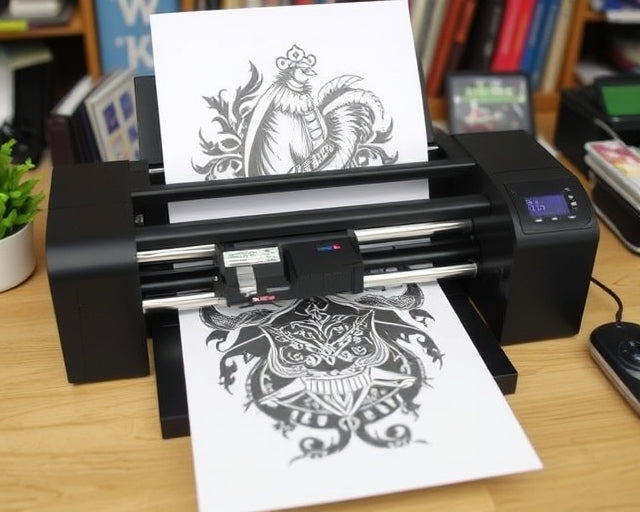
Stop searching for a temporary tattoo for 6 months. It is an aesthetic trap that yields poor results. We recommend a much more practical, professional approach to testing tattoo designs: use a thermal stencil printer. By printing your design on professional transfer paper, you can apply the purple stencil outline directly to your body. It will last through a few showers (typically 2 to 4 days), giving you ample time to stare at it in the mirror, check the placement, and ensure the sizing is perfect. If you need to know can a normal printer print tattoo stencils, the answer is no—you need dedicated thermal technology.

Frequently Asked Questions
Is there any temporary tattoo that lasts exactly 6 months?
No. Biologically, anything applied to the surface of your skin will shed within 28 days due to natural cell turnover. Anything injected deeper into the dermis relies on your immune system to break it down, which is highly unpredictable and often takes years to fade completely.
Do made-to-fade tattoos hurt as much as real tattoos?
Yes. Made-to-fade inks (like Ephemeral) are applied using standard professional tattoo machines and needles. They penetrate the skin to the exact same depth as permanent tattoos, meaning the pain level and the healing process are completely identical.
How can I test a tattoo design before getting it permanently?
In most professional situations, the best method is to have an artist print the design using a thermal stencil printer and apply the transfer paper to your skin. This leaves a crisp purple outline that will last for a few days, allowing you to evaluate the size, placement, and flow on your body.
Are temporary tattoo inks FDA approved?
The FDA does not currently approve any tattoo inks (permanent or temporary) for injection into the skin. They consider tattoo inks to be cosmetics. Always exercise caution and research the manufacturer before allowing any chemical to be injected into your dermis.
Industry References & Authoritative Science
To ensure our claims regarding skin biology and ink retention meet the highest standards of E-E-A-T, INKSOUL® bases our practical guidelines on data from the following medical and regulatory authorities:
- U.S. Food and Drug Administration (FDA): Official regulatory guidelines and safety warnings regarding the cosmetics industry, tattoo inks, and the lack of federal approval for dermal injection polymers. Review FDA Tattoo Safety Data
- American Academy of Dermatology (AAD): Medical literature explaining the cellular turnover rate of the human epidermis (stratum corneum to basal layer) and the function of dermal macrophages in ink retention. Review AAD Dermatological Guidelines
- Mayo Clinic: Clinical overviews of the risks associated with tattooing, including allergic reactions to foreign pigments, granulomas, and MRI complications. Review Mayo Clinic Tattoo Risks