
The global tattooing sector has evolved from an underground subculture into a highly professional, tech-driven industry where precision engineering meets fine art. As clients demand increasingly complex compositions, ranging from hyper-realistic portraiture to intricate geometric sleeves, the preparation stage of the tattoo has become a critical operational phase. A tattoo stencil serves as the vital link between conceptual design and permanent skin integration, making stencil application accuracy paramount for any professional studio workflow.

From our experience at INKSOUL, the choice of stencil creation methodology directly dictates studio throughput, design fidelity, and artist physical fatigue. While veteran practitioners often favor traditional physical drawing styles, modern digital pipelines minimize errors and permit swift scaling for large body placements. In this comprehensive analysis, we present a balanced comparison of 5 different tattoo design methods, examining traditional manual drawing, light box reproduction, freehand skin marker composition, classic desktop thermal copiers, and modern high-resolution wireless template printer devices.
Table of Contents
- 1. Traditional Manual Tracing and Freehand Paper Drawing
- 2. Light Box Replication and Layered Sketch Transfer
- 3. Direct Freehand Skin Marker Composition
- 4. Standard Desktop Heavy Thermal Copiers
- 5. Advanced Portable Wireless Template Printers
- 6. Technical Evaluation and Comparison Matrix Table
- 7. Studio Workflow Optimization: Beyond the Design Phase
- 8. Sourcing Innovation: The INKSOUL Hardware Blueprint
- 9. Frequently Asked Questions (FAQs)
- 10. Professional Horology and Dermatological References
1. Traditional Manual Tracing and Freehand Paper Drawing

Before digital technology entered the studio space, manual tracing on carbon-backed paper was the foundational standard for stencil replication. In this method, an artist places a sheet of tracing paper over an initial sketch and manually traces every line using a ballpoint pen to transfer carbon onto the template paper. This process demands a high level of physical consistency and unwavering fine-motor control over prolonged periods.
From our experience, manual tracing provides an excellent way for apprentices to build muscle memory and deeply understand the line architecture of a composition before tattooing. However, for a busy commercial studio, this approach introduces substantial efficiency limits. Tracing a full-back Japanese traditional design or a highly detailed mandala can consume hours of preparation time. Furthermore, manual drawing lacks a pathway to reproduce soft gradients or smooth shading transitions, forcing the artist to manually map out shadow borders using complex topographical lines.
2. Light Box Replication and Layered Sketch Transfer
The introduction of the backlit light box or LED tracing pad provided a useful mechanical upgrade over basic tabletop manual tracing. By illuminating the original reference artwork from underneath, a light box allows artists to see through heavy-weight carbon papers easily, making it simpler to copy fine details and track intricate line structures cleanly.
We recommend LED light boxes for custom flash adaptations where artists need to combine elements from multiple physical reference sheets into a unified layout. However, it still shares the core liabilities of traditional manual tracing. The process remains slow and relies heavily on manual drawing accuracy. If an artist slips during a long tracing session, the entire template paper sheet can be ruined, forcing them to scrap the sheet and start the replication process over from scratch.
3. Direct Freehand Skin Marker Composition
Direct freehand skin mapping skips paper transfers completely. The artist works directly on the client's skin using specialized surgical markers and antiseptic skin preparation pens to draw the design architecture in real time. This raw, unconstrained method allows the composition to follow the body's natural curves and muscle anatomy perfectly.
This approach is highly effective for large biomechanical pieces, fluid illustrative scriptwork, and cover-up projects where the layout must actively wrap around existing ink patterns. However, we recommend this design path exclusively for highly experienced tattooists who possess a strong grasp of anatomical distortion. For beginners, working without a pre-printed reference lines introduces a high risk of proportion errors. Additionally, surgical marker ink can blur or wipe away easily during early machine passes if the skin preparation phase is not executed perfectly.
4. Standard Desktop Heavy Thermal Copiers
The desktop thermal copier was the first true automation tool introduced to the tattoo stencil workflow. These heavy analog machines use infrared lamps to read carbon-based prints from standard laser printers and replicate the design lines onto carbon transfer sheets using precise heat application.
Using thermal copiers cut stencil preparation times down from hours to seconds, vastly increasing daily studio capacity. However, these machines have notable drawbacks, including high electricity use, loud cooling fans, and a tendency to jam if the internal glass rollers gather carbon dust. They are also limited to rigid, standard line images, making it impossible to copy soft stipple gradients or fine photo-realistic gray tones without printing high-contrast line work first.
5. Advanced Portable Wireless Template Printers
The modern milestone in stencil creation is the digital wireless template printer. These compact devices utilize high-resolution thermal printheads to receive digital vector designs or high-contrast image files straight from mobile devices, tablets, or computers, skipping the need for an initial paper print entirely.
We recommend portable wireless template printers for busy studios, travelling guest artists, and international convention environments where space and speed are primary constraints. By utilizing direct thermal printing technology, these units remove the need for expensive ink cartridges, ribbons, or replacement toners. They allow artists to scale, mirror, and edit line work or complex shading layouts instantly on a tablet interface, printing a flawless stencil in seconds with zero risk of manual tracing distortion.
6. Technical Evaluation and Comparison Matrix Table
To assist shop managers and independent tattooists in analyzing the comparison of 5 different tattoo design methods, the following responsive matrix table aggregates the core operational metrics of each design path.
| Design Methodology | Average Prep Time | Shading & Gradient Capacity | Anatomical Adaptability | Consumable Operating Costs |
|---|---|---|---|---|
| Manual Paper Tracing | High (60 - 180 mins) | None; requires manual boundary mapping | Moderate; requires manual stretching lines | Low; stencil paper & tracing sheets |
| Light Box Replication | Moderate (30 - 90 mins) | Low; visual guide lines only | Moderate; fixed sheet dimensions | Low; LED power & template paper sheets |
| Direct Freehand Skin Marking | High (45 - 120 mins) | High; custom marker shading layers | Maximum; fits muscle contours perfectly | Low; medical skin markers & prep fluids |
| Desktop Thermal Copier | Ultra-Low (1 - 2 mins) | None; strictly high-contrast line work | Moderate; relies on printed paper limits | High; laser prints & carbon sheets |
| Wireless Template Printer | Ultra-Low (< 1 min) | Maximum; supports smooth shadow print paths | High; quick digital sizing and mirroring | Minimum; direct A4 thermal sheets only |
7. Studio Workflow Optimization: Beyond the Design Phase
While selecting a high-fidelity stencil creation method is essential for clean design transfers, maintaining long-term studio efficiency relies on setting up a cohesive material workflow across all tattooing stages. Even a technically perfect stencil will fade or smear if secondary variables are poorly managed. For example, when training new talent, ensuring your artists understand correct fluid parameters is vital. Sourcing teams can consult our comprehensive guide on the tattoo ink for beginners tier to learn how different pigment saturations interact with newly transferred stencil outlines.
Furthermore, maintaining an immaculate workstation setup prevents cross-contamination and minimizes setup delays between appointments. We recommend implementing standardized station cleaning routines. Using specialized tools like our high-performance tattoo needle cleaning supplies ensures needle configurations remain free from pigment sludge during multi-hour lining sessions. To streamline your pigment storage and display systems, studio managers can integrate our smooth-rotating tattoo ink display rack modules, keeping colors easily organized and accessible during long sessions.
8. Sourcing Innovation: The INKSOUL Hardware Blueprint
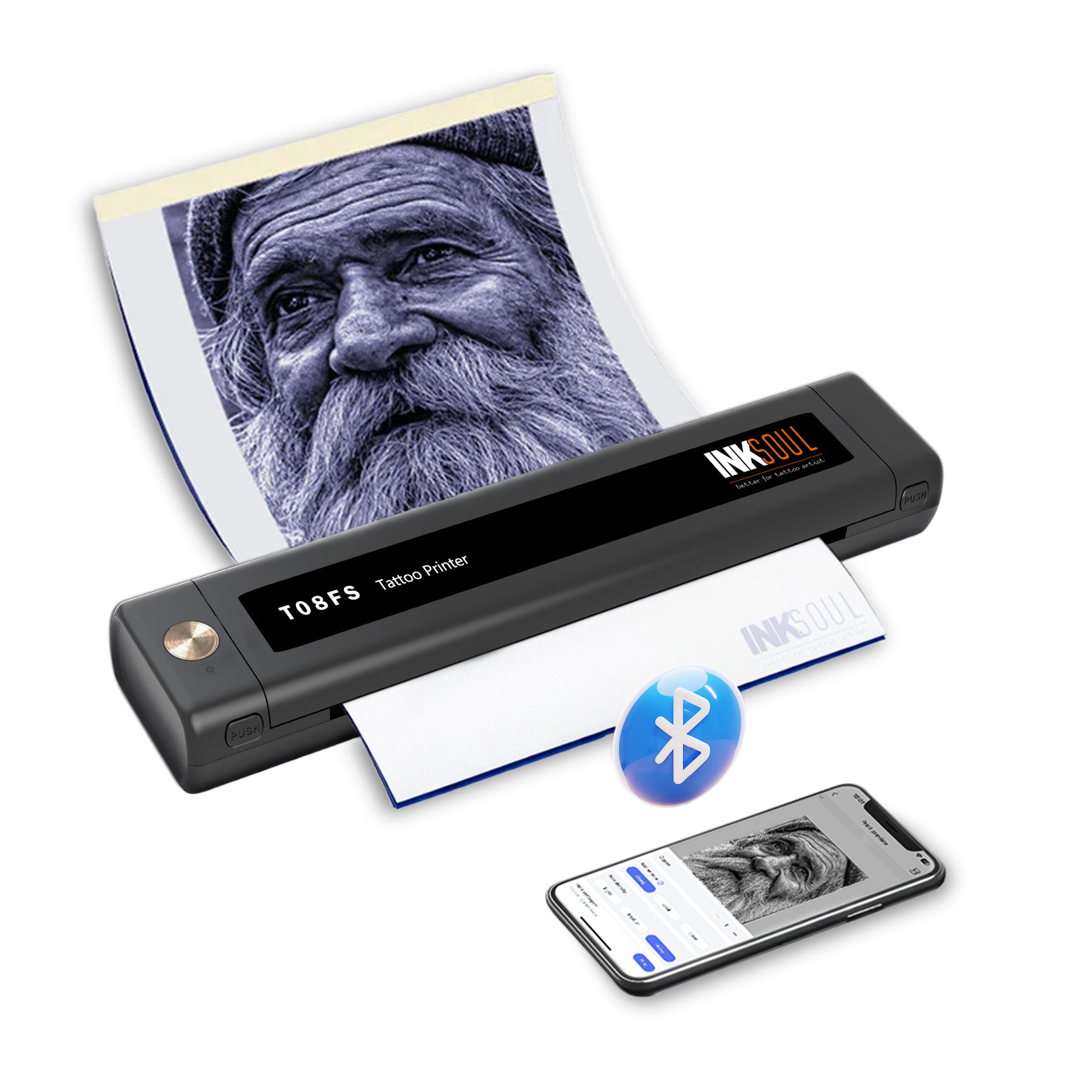
When analyzing the comparison of 5 different tattoo design methods, modern studios prioritize hardware choices that balance high technical accuracy with low operating costs. The INKSOUL® T08FS Wireless Tattoo Transfer Stencil Printer-Can print shadows represents the pinnacle of digital stencil technology, offering a complete solution for busy modern tattooists. Engineered with an integrated 1200mAh lithium battery and stable Bluetooth paths for smartphones and tablets, it provides true portable freedom for convention circuits, while its secure USB cable path enables simple desktop PC connectivity.
Operating with a crisp 203 dpi resolution and printing speeds of 13-15 mm/s, this advanced thermal printing unit easily outputs complex line art and detailed shader images across variable printing lengths from 20mm up to 400mm. The system supports four distinct paper sizes to accommodate diverse body placement layouts (A4: 8.3in*11.7in; LTR: 8.8*11in; Legal: 8.5in*14in; LTR+: 8.5in*16.5in). Because the tattoo paper uses the most economical thermal technology, you just need to refill A4 thermal paper, no ink cartridges, no ribbons. This inkless configuration lowers ongoing operating costs while ensuring clear, reliable stencil transfers across all skin types.
To ensure flawless application results, the physical lighting environment must be fully optimized to eliminate glare and prevent eye strain during micro-lining phases. Artists can explore our curated tattoo lighting equipment collections to build ideal glare-free setups, or integrate our specialized tattoo mixer supply arrays to achieve ultra-smooth, uniform pigment blends for soft grey-wash work. Additionally, for artists looking to test large-scale layout options or provide temporary sample alternatives for indecisive clients, exploring our detailed user manual on temporary tattoo ideas or reviewing our field feedback on the best temporary tattoo pens review helps expand your studio's versatile creative capabilities.
9. Frequently Asked Questions (FAQs)
10. Professional Horology and Dermatological References
1. International Organization for Standardization. (2023). Tattooing — Safe and hygienic practice — Requirements and guidance for professional studios (ISO Standard No. 24816:2023). Available via https://www.iso.org/)
2. Journal of Clinical and Aesthetic Dermatology. (2025). Evaluation of Dermal Transfer Dynamics, Polycyclic Aromatic Hydrocarbons, and Dermal Safety Profiles in Thermal Stencil Carbon Formulations. Dermatological Research Network Portfolio.
3. Alliance for Professional Tattooists. (2026). Studio Sourcing Manual: Mitigating Cross-Contamination and Maximizing Line Fidelity via Digital Thermal Templates. APT Global Reference Database.

