Ask a non-tattooer what a tattoo needle is and they'll picture a single sharp point, like a sewing needle. Ask a working artist and you'll get a different answer: a tattoo needle is never one needle. It is a group of fine needles, soldered together in a precise geometric arrangement, and that geometry — not the machine, not the ink — is what decides whether the mark on skin becomes a crisp line, a soft gradient, or a solid field of color.

This guide is the complete, no-assumptions explainer: what tattoo needles actually are, how traditional bar needles differ from modern cartridges, what every grouping code means, how gauges and tapers change the way a needle feels, and how professional artists think when they reach for one box instead of another. If you want the buying-focused companion to this guide — which configuration for which technique, brand picks, and how to verify genuine stock — see our cartridge needle buying guide.
What Are Tattoo Needles, Really?
Strip away the packaging and a tattoo needle does one job: it carries pigment into the dermis — the stable middle layer of skin, roughly 1–2 mm below the surface — and leaves it there. Epidermis (the top layer) sheds constantly, which is why anything deposited too shallowly fades; go too deep and the ink spreads into a blurry halo. The needle's entire design exists to hit that narrow window, thousands of times per minute, with absolute consistency.
That consistency is why needles come in groups. A single needle point would tear skin and deposit ink unevenly. Instead, manufacturers solder anywhere from 1 to 49+ individual needle points into formations — tight circles for lines, flat rows for shading — and the formation determines the mark. Change the formation and you change the tool: the same machine, the same hand, the same ink will produce a hairline with a 3-round-liner and a soft wash with a curved magnum. Understanding groupings is, in a very literal sense, understanding the alphabet of tattooing.
Two quality baselines govern the whole industry. First, the steel: reputable manufacturers use surgical-grade stainless steel (the industry standard is 316L) because it holds a sharp point, resists corrosion, and is biocompatible. Second, sterility: every needle that touches skin must arrive in factory-sealed, E.O.-sterilized (ethylene oxide) packaging, be single-use, and be discarded after one client. These aren't premium features — they're the floor. Any needle sold without verifiable sterilization isn't a bargain; it's a liability.
Why does needle quality set the ceiling on your work? Because the needle is the last thing between your intention and the skin. A premium machine can't fix uneven needle heights in a cheap grouping; no ink can compensate for a dull point dragging through tissue. Artists who upgrade their needles before their machines almost always see the bigger improvement — and spend less doing it.

Bar Needles vs. Cartridge Needles
There are two physical formats, and the industry spent about a decade migrating from one to the other.
Traditional bar needles are the original format: a group of needles soldered onto a long metal bar. The bar slides into a reusable steel or disposable tube; a rubber band or grommet provides the tension that returns the needle after each hit. The tubes must be autoclaved (steam-sterilized) between clients, the machine gets wrapped in barrier film, and setup takes real time and real discipline. Bar needles pair with coil machines and with rotary machines via standard tubes — it's the workflow most artists over 40 learned on.
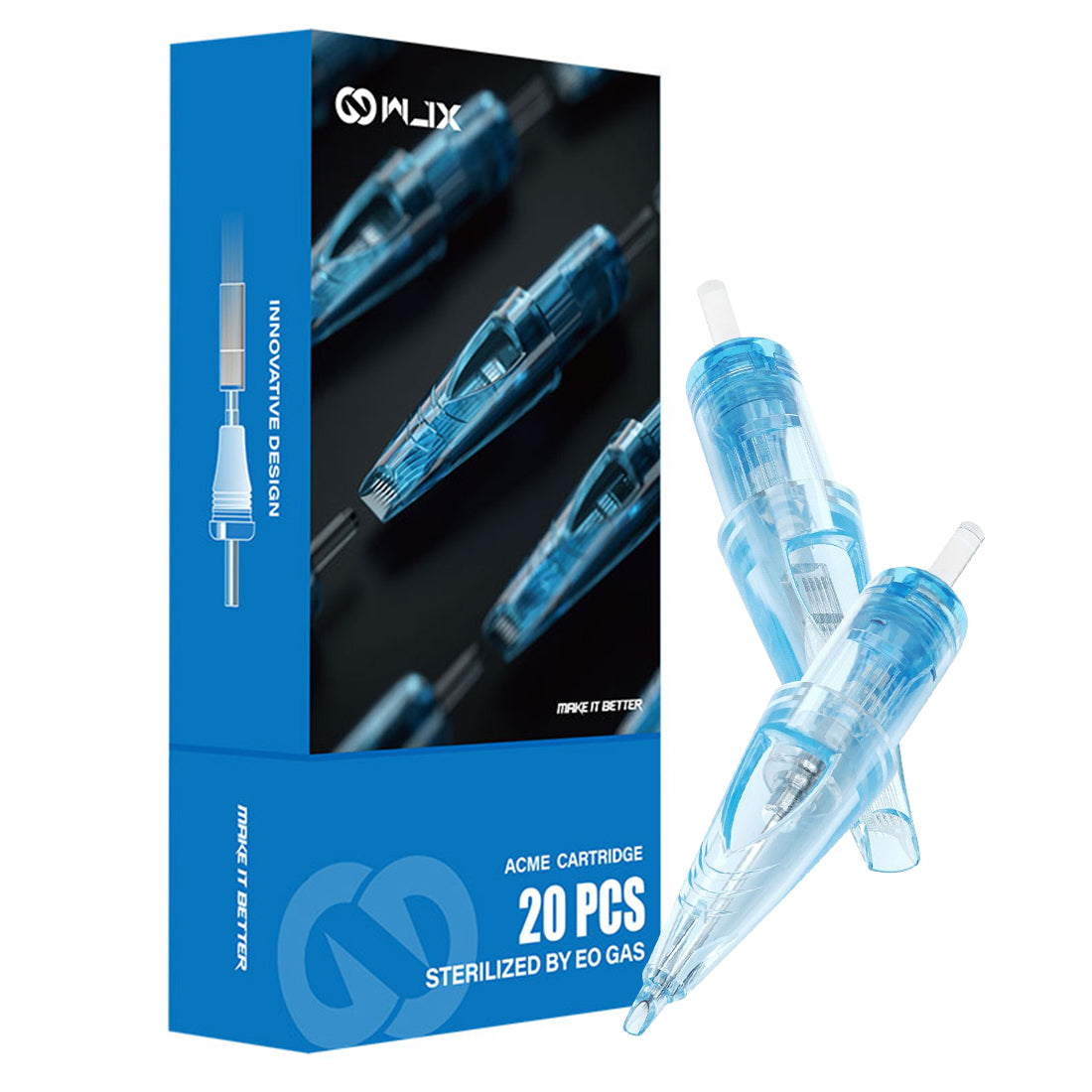
Cartridge needles are the modern format: the needle group comes pre-assembled inside a self-contained plastic housing with a twist-lock base. You click it into a cartridge grip, tattoo, and throw the whole unit away. Each cartridge is factory-sterilized and sealed, and a silicone membrane inside the housing acts as a one-way valve that blocks ink and bodily fluid from traveling back into the machine. Setup takes seconds; cross-contamination control is dramatically simpler.
An honest comparison, dimension by dimension:
- Setup speed: cartridges win by a mile — seconds versus the full tube-and-autoclave ritual.
- Hygiene chain: cartridges reduce the number of things that can go wrong. Bar-needle hygiene is perfectly safe when done right, but "when done right" includes a flawless autoclave routine, every single time.
- Machine pairing: cartridges need a pen-style rotary machine with a cartridge grip; bar needles work with coils and tube-based rotaries.
- Cost per unit: bar needles are cheaper per needle, which is why some high-volume shops still keep them for specific jobs.
- Feel: the membrane in a cartridge adds a slight cushion to the hit. Most artists adjust within a session.
Are bar needles obsolete? Not entirely — some old-school artists still prefer them for large soft-shading work, and the per-unit economics are real. But for most working artists in 2026, cartridges are the default format, and every "which needle should I buy" decision downstream assumes cartridges. Our cartridge needle buying guide picks up where this section ends: configurations, gauges, brand picks, and authenticity checks.
Needle Groupings Explained: RL, RS, Magnum, Curved Magnum, Flat
Every needle box prints a code. Learn it once and the wall of options at any supply shop becomes readable.
Round Liner (RL) — needles soldered in a tight circle, converging to a single point. The outlining workhorse. A 3RL draws hairline detail; a 9RL or 14RL lays down bold traditional outlines. If the job is lines, you live in RL territory.
Round Shader (RS) — the same round arrangement, but the needles sit looser so the points spread slightly. More ink per pass than a liner without the hard edge — the tool for small-area fills, whip shading, and soft black-and-grey where a magnum would be overkill.
Magnum (M1) — two stacked rows of needles forming a flat rectangular footprint. The shading and color-packing engine: large, even coverage for gradients, color fills, and backgrounds.
Curved (Round) Magnum (CM / RM) — a magnum with the tips arranged in a gentle arc. The outer needles sit slightly higher, so edges come out softer with less trauma on curved body surfaces. Many artists now default to curved magnums for nearly all shading work.
Flat (F) — needles in a single straight row. Less common in cartridge form today, but useful for geometric work and certain lining effects.
The number before the letters is the needle count: 5RL means five needles in a round-liner formation; 15M1 means fifteen in a magnum. More needles, wider coverage; fewer needles, finer detail. Round liner vs. round shader is the comparison beginners ask about most: same circle, different tightness — liners for edges, shaders for soft fill.
This section covers what each grouping is. For which grouping to use on which technique — the practical matching chart — see our cartridge needle buying guide, which includes the full technique cheat sheet.
Gauges and Tapers: #8 / #10 / #12 and Long vs. Short Taper
Gauge is needle diameter, and the industry shorthand is simple: #12 = 0.35 mm, #10 = 0.30 mm, #8 = 0.25 mm. Smaller number, thinner needle.
- #12 (0.35 mm) — the standard. Stiffer needles, bolder lines, faster ink deposit. Default for traditional work, bold linework, and color packing.
- #10 (0.30 mm) — the middle ground. Slightly finer than #12 with good control; popular for detailed linework and moderate shading.
- #8 (0.25 mm, "bugpin") — the finesse option. Very fine needles that group tightly for delicate lines and buttery soft shading with minimal trauma. The go-to for fine-line tattoos and smooth black-and-grey gradients. Trade-off: thinner needles flex more and deposit ink more slowly.
Taper is the length of the needle's sharpened point — how gradually it narrows to the tip. It's the least-discussed spec and one of the most felt in the hand:
- Long taper — a gradual point that enters skin smoothly and deposits ink in a tight, controlled way. Best for crisp lines and fine detail; most artists' default.
- Medium taper — balanced ink flow with reasonable precision; a good general-purpose choice.
- Short taper — a stubby point that dumps ink fast. Built for solid color fills and bold traditional work; less precise for detail.
A practical rule from working artists: if your lines look great but color packing feels weak, try a shorter taper before switching brands. If shading looks peppery and harsh, a longer taper — especially in a bugpin magnum — is usually the fix. Taper is a tuning knob, not a brand loyalty test. For the buying side of this (which gauges to actually stock, and how many boxes), our cartridge needle buying guide has the specifics.

Sterilization & Hygiene Basics
Every needle that touches skin must be sterile, single-use, and verifiably so. Here's the baseline every artist — and every buyer — should be able to recite:
- E.O. sterilization is the industry standard for pre-packaged needles: ethylene oxide gas sterilizes without the heat that would dull fine points.
- Individual blister packaging maintains the sterile barrier until the moment of use. Check every blister before opening: no punctures, no compromised seals.
- Expiry dates are real. The sterile guarantee has a clock on it. Expired needles may no longer be sterile — don't use them, no matter how tempting the discount box.
- Single use means single use. One client, one needle, then the sharps container. A damaged blister means the whole unit is discarded unopened.
One warning worth its own paragraph: anonymous cartridges with unverifiable sterilization are a client-safety risk, full stop. "E.O. sterilized" printed on a box means nothing without a traceable manufacturer and batch records behind it. Why buying genuine needles matters goes deep on this — gray-market cartridges, inconsistent groupings, and the authenticity checks that protect your clients. Read it before you buy in bulk from an unfamiliar source.
How Artists Actually Choose: Technique First
Beginners shop by brand. Professionals shop by technique. The decision order that experienced artists actually use:
- Technique first. What is the job? Bold outlines, soft shading, solid color, fine detail — each points to a grouping family (RL, magnum, RS, bugpin liner).
- Grouping second. Match the formation to the mark you need to make.
- Gauge and taper last. Fine-tune the diameter and point length for the skin, the ink load, and your hand speed.
Three of the most common scenarios, as examples:
- Bold traditional piece → large RL (#12) for outlines, flat or curved magnum (#12, short taper) for packing.
- Black-and-grey realism → small RL (#10) for detail, curved bugpin magnum for gradients.
- Fine-line minimalist → 1RL–3RL bugpin; almost nothing else in the kit.
And the method for dialing in a new configuration: change one variable at a time. If you switch from #12 to bugpin and from flat to curved magnum in the same session, you'll never know which change fixed the problem. Buy small counts when experimenting — a 20-piece box is enough to evaluate — then commit. The complete technique-to-configuration chart lives in our cartridge needle buying guide.
Caring for Your Needles: Storage & Disposal
Needles are consumables with a clock on them. Treat them that way:
- Storage: room temperature, dry, away from direct sunlight. Heat and UV degrade packaging seals and the lubricant on the needles.
- Don't over-stockpile. Buy what you'll use within a reasonable window. A drawer full of expired cartridges is money in the bin — and a temptation to use something you shouldn't.
- Disposal: used needles are sharps waste. Puncture-proof sharps container, never the regular trash. Your local regulations govern the details; the container is non-negotiable everywhere.
- Damaged stock: crushed boxes, punctured blisters, or faded expiry printing — discard. The cost of one box is nothing next to the cost of an infection.
Glossary: Tattoo Needle Terms A–Z
Bugpin — #8 gauge (0.25 mm) needles; very fine, for delicate lines and soft shading.
Cartridge needle — needle group pre-assembled in a disposable twist-lock housing; factory-sterilized, single-use.
Curved magnum (CM / RM) — magnum with tips in a gentle arc; softer edges, less trauma.
E.O. sterilized — sterilized with ethylene oxide gas; the industry standard for packaged needles.
Flat (F) — needles in a single straight row; geometric work and lining effects.
Gauge — needle diameter: #12 = 0.35 mm, #10 = 0.30 mm, #8 = 0.25 mm.
Magnum (M1) — two stacked rows forming a flat rectangle; shading and color packing.
Membrane — silicone one-way valve inside a cartridge that blocks backflow into the machine.
Round liner (RL) — needles in a tight circle converging to a point; outlines.
Round shader (RS) — looser round grouping; soft fill and whip shading.
Taper — length of the needle's sharpened point; long = precise, short = fast ink deposit.
Frequently Asked Questions
What are tattoo needles made of?
Reputable manufacturers use surgical-grade stainless steel (316L is the industry standard) — it holds a sharp point, resists corrosion, and is biocompatible. The steel matters less than most beginners think; the grouping geometry and the sterile packaging matter more.
Are tattoo needles sterile when you buy them?
They should be: factory-sealed, E.O.-sterilized, with an expiry date on each blister. Always inspect the packaging before opening. If the sterile barrier is compromised — punctures, broken seals, expired dates — discard the unit.
What's the difference between a round liner and a round shader?
Both are round groupings; liners converge to a tight point for crisp edges, while shaders sit looser so the points spread slightly for softer ink deposit. RL for outlines, RS for soft fill and whip shading.
Can tattoo needles be reused?
No. Modern needles — bar or cartridge — are single-use. Reusing a needle is a severe biohazard violation and risks transmitting bloodborne pathogens. One client, one needle, then the sharps container.
Bar needles vs. cartridge needles — which should a beginner learn on?
Cartridges. Faster setup, simpler hygiene, and they pair with the pen machines most studios run today. Bar needles are worth understanding (this guide), but cartridges are what you'll actually buy — start with our cartridge needle buying guide.
The Bottom Line
A tattoo needle is a grouping geometry with a job to do: RL for lines, RS for soft fill, magnums — preferably curved — for shading and color, in the gauge and taper your technique demands. Learn the codes once and the entire wall of options becomes a menu instead of a maze. When you're ready to buy, our tattoo needles collection carries every configuration in this guide as genuine, factory-sterilized stock — and for the full buying walkthrough, shop tattoo cartridge needles with our technique chart at your side.