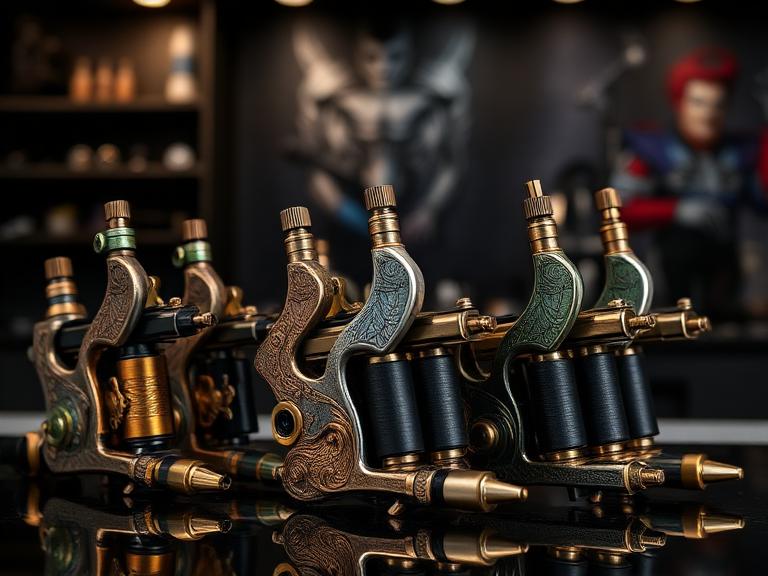
Searching the internet for a cool tattoo machine usually yields a flood of superficial results highlighting sleek aluminum finishes, LED light rings, and aggressive branding. In the professional tattooing industry, visual aesthetics mean absolutely nothing if the motor bogs down pushing a 14RL grouping into tough skin. True "coolness" in a tattoo machine is defined by uncompromising mechanical reliability, ergonomic weight distribution, and the technological ability to adapt to any artistic style seamlessly.

From our experience working alongside elite artists and auditing supply chains at Inksoul, the modern definition of a top-tier machine is a wireless rotary pen that offers variable stroke lengths without requiring a mid-session teardown. When you are six hours into a grueling back piece, you do not care about the laser-etched skull on your motor housing; you care about voltage consistency, needle membrane penetration, and preventing debilitating hand fatigue. In this definitive guide, we strip away the marketing fluff to evaluate the true mechanical performance of the top 7 machines on the market, providing the unvarnished facts you need to make a sound commercial investment.
Quick Answer
The definitive best cool tattoo machine currently on the market is the Dragonhawk Mast Fold 2 Pro. It earns this title not through flashy gimmicks, but through its unparalleled mechanical versatility. Offering an instantly adjustable stroke length ranging from 2.4mm (for ultra-soft black and grey shading) up to 4.2mm (for aggressive color packing and bold lining), it eliminates the need to swap between multiple machines during a session. For commercial users demanding peak wireless tattoo gun battery life and seamless cartridge compatibility, this machine delivers premium performance at an accessible price point.
Table of Contents
- What It Is: Redefining the Modern Machine
- How It Works: Rotary Architecture
- The 7 Best Cool Tattoo Machines Tested
- Commercial Benefits of Upgrading
- Inherent Limitations
- Who Should Use Wireless Pens
- Who Does Not Need Them
- Common Purchasing Mistakes
- Strict Buying Considerations
- Expert Recommendation
- Summary and Comparison Tables
- Frequently Asked Questions
What It Is: Redefining the Modern Machine
In the current landscape of professional tattoo machines, the standard has shifted entirely away from heavy, tethered electromagnetic coil setups toward lightweight, wireless rotary pens. A cool tattoo machine in today's market is a self-contained ecosystem. It houses a high-torque brushless motor, an internal lithium-ion power supply, and an adjustable cam mechanism inside a single, sterilizable aircraft-grade aluminum chassis.
These devices are engineered to mimic the feel of a thick marker, drastically reducing the repetitive strain injuries that plagued previous generations of artists. By eliminating RCA cords and external power supplies, artists gain complete 360-degree freedom of movement around their clients.
How It Works: Rotary Architecture
Traditional coil machines use electromagnetic currents to pull an armature bar down, driving the needle via a spring mechanism. Modern rotary pens operate on a completely different mechanical principle. A direct-drive rotary motor spins a cam wheel. An eccentric bearing attached to this wheel converts the circular spinning motion into a linear up-and-down (reciprocating) drive bar movement.
The distance the drive bar pushes the needle out of the cartridge is the "stroke length." Short strokes (2.4mm - 3.0mm) hit softly and rapidly, making them perfect for seamless black and grey blending. Long strokes (4.0mm+) hit with immense mechanical force, pulling the needle back far enough to pick up thick pigment and punch bold lines in a single pass. Understanding this geometry is critical when consulting a tattoo needle sizes guide to match your hardware to your application.
The 7 Best Cool Tattoo Machines Tested
We evaluated the market to identify the absolute best hardware, focusing heavily on motor torque, voltage stability under load, and center-of-gravity ergonomics. Here are the top performers among the best tattoo machines 2025 has to offer.
- Dragonhawk Mast Fold 2 Pro: The apex of versatility. Features an on-the-fly adjustable stroke (2.4mm to 4.2mm) and a high-capacity custom coreless motor. It is the ultimate all-rounder for artists who refuse to switch machines mid-session.
- FK Irons Flux Max: A premium, heavyweight contender known for its PowerBed technology and highly intuitive digital menu. It is an exceptional machine, though significantly more expensive than its competitors.
- Cheyenne Sol Nova Unlimited: The pioneer of the one-button interface. It uses motion control (tilting the machine) to adjust voltage. Incredibly reliable, but lacks an LED screen for exact voltage readouts.
- Bishop Rotary WAND: Available in specific, fixed-stroke configurations (Liner, Packer, Shader). The magnetic battery connection is brilliant, but you must purchase multiple machines if you practice diverse styles.
- Inkjecta Flite X1: Visually unique and mechanically complex. It offers immense customization via interchangeable torsion bars and cams. Best suited for highly experienced tech-heads who love to tinker with give and hit.
- Axys Valhalla: A highly respected adjustable stroke machine. It operates flawlessly, but the overall chassis design feels slightly dated compared to the sleek integrations of newer models.
- Peak Solice: An excellent modular choice for beginners and intermediates. It offers the ability to switch between a wireless battery pack and a standard RCA module if you forget to charge your batteries.
Commercial Benefits of Upgrading
Upgrading to a premium wireless rotary pen directly impacts your hourly profitability. First, setup and teardown times are slashed because there are no clip cords or power supply units to bag in protective plastic. Second, the ergonomic balance drastically reduces hand, wrist, and forearm fatigue, allowing artists to comfortably execute 8-hour sessions without their line quality degrading in the final hours.
Inherent Limitations
We must use commercial and practical judgment: wireless rotary pens are not invincible. The primary limitation is battery degradation. Lithium-ion cells naturally lose their charging capacity after 500 to 1,000 cycles. If you purchase a machine with a built-in, non-removable battery, the entire machine becomes a paperweight when the battery dies. Always select machines with modular, swappable power packs.
Furthermore, rotary motors lack the natural "give" (spring tension) of a coil machine. If you are heavy-handed, a direct-drive rotary will chew up the client's skin much faster than a coil. You must actively adjust your hand speed and voltage to compensate.
Who Should Use Wireless Pens
We recommend these machines for traveling artists attending conventions, realism specialists who require ultra-soft, consistent shading gradients, and any professional suffering from early signs of carpal tunnel syndrome. Furthermore, if you are sourcing inventory from the top tattoo machine brands, these models ensure you stay at the forefront of hygiene compliance by eliminating cord cross-contamination.
Who Does Not Need Them
If you are an uncompromising traditionalist who specializes exclusively in heavy American Traditional, you may still prefer the aggressive punch and visceral feedback of a heavy iron coil machine. Additionally, scratchers operating out of unsterile environments do not need to invest in premium hardware; they need to invest in a legitimate apprenticeship.
Common Purchasing Mistakes
The most catastrophic mistake artists make is buying a machine with a fixed 3.5mm stroke and expecting it to perfectly push a massive 14RL (Round Liner) grouping. Pushing heavy needle configurations requires immense torque and a longer stroke (4.0mm+). If you do not understand the physics outlined in the rs vs rl tattoo needles debate, you will overwork the motor and traumatize the skin.
Another profound error is buying unbranded, generic machines from wholesale websites. These units utilize cheap brushed motors that suffer from severe voltage drop under load. When the needle hits the skin, the motor slows down, causing the needle to snag and tear the dermis.
Strict Buying Considerations
When executing your procurement strategy, demand absolute clarity on the motor type. Accept nothing less than a custom coreless or brushless Faulhaber-style motor. Verify that the grip diameter aligns with your hand size; a grip that is too narrow forces you to pinch the machine aggressively, causing cramping. Finally, ensure the machine mechanism is strong enough to push the stiff silicone membranes found in the best tattoo needle brands without bogging down.
Expert Recommendation
In our rigorous testing, identifying a cool tattoo machine requires balancing aesthetic appeal with brutal mechanical efficiency. You need a machine that adapts to your daily workflow, not one that forces you to change your style. We strongly recommend abandoning fixed-stroke machines if you are a versatile artist handling both fine-line script and color packing in the same week. The ability to shift stroke lengths with a simple click is the most significant technological leap in the industry in the last decade.

Dragonhawk Wireless Tattoo Pen Machine 2.4-4.2MM Strokes Length | Mast Fold 2 Pro
Unleash your artistry with the Dragonhawk Mast Fold 2 Pro. This is not just a tool; it is a comprehensive workstation in the palm of your hand. A wireless tattoo pen machine featuring an instantly adjustable 2.4-4.2mm stroke for precision inking across any style. Designed for artists who demand a cool aesthetic backed by relentless coreless motor performance.
- Adjustable Stroke: 7 pre-set lengths (2.4, 2.7, 3.0, 3.3, 3.6, 3.9, 4.2mm)
- Motor: Custom Coreless Motor for zero voltage drop
- Battery Capacity: High-density 1500mAh module
- Working Voltage: 4V - 12V Precision Control
Summary and Comparison Tables
| Feature | Why It Matters | Professional Standard |
|---|---|---|
| Coreless/Brushless Motor | Maintains consistent needle speed upon skin contact. | Zero bog-down, prevents skin tearing. |
| Adjustable Stroke | Allows one machine to line, pack color, and shade softly. | 2.4mm to 4.2mm range. |
| Modular Battery | Prevents the machine from becoming useless when cells degrade. | Hot-swappable batteries with fast USB-C charging. |
| Aircraft Aluminum Chassis | Ensures durability and tolerates aggressive chemical sterilization. | Lightweight center of gravity. |
| Specification | Fixed Stroke (e.g., Bishop WAND) | Adjustable Stroke (e.g., Mast Fold 2 Pro) |
|---|---|---|
| Mechanical Complexity | Low (Fewer moving parts, highly durable) | High (Complex cam system requires precision engineering) |
| Versatility | Low (Requires multiple machines for different tasks) | Exceptional (One machine handles all styles) |
| Cost Efficiency | Poor (Must buy a Liner and a Shader separately) | Excellent (All-in-one commercial solution) |
| Pros (Advantages) | Cons (Limitations) |
|---|---|
| Total freedom of movement without tripping over RCA cords. | Adds physical weight to the top of the machine (back-heavy). |
| Eliminates the cost and clutter of external power supplies. | Requires managing charge cycles between long appointments. |
| Vastly superior cross-contamination prevention (no cord to bag). | If the digital screen fails, the voltage cannot be adjusted. |
Found your match? Get it genuine in our tattoo pen machine collection — authorized dealer, verifiable serials, real support.
Frequently Asked Questions
Does stroke length really matter for a beginner?
Absolutely. Stroke length dictates the mechanical force and needle hang. A short 2.5mm stroke hits softly and is excellent for smooth shading but will fail to push ink deep enough for bold outlines. A long 4.0mm stroke hits hard, packing solid color effortlessly but can cause severe scarring if used for soft black and grey work by an inexperienced hand.
How do I sterilize a wireless tattoo pen?
Unlike stainless steel grips, you cannot place a machine housing containing lithium batteries and digital screens into an autoclave. You must thoroughly wipe the entire machine down with hospital-grade surface disinfectants (like CaviWipes) and completely seal the machine in a sterile barrier bag or machine sleeve prior to every procedure.
Are cheap tattoo machines from Amazon safe to use?
In most professional situations, ultra-cheap, unbranded machines are a severe liability. They use inferior motors that fluctuate in voltage, causing the needle to snag and drag through the skin. This results in heavy trauma, poor healing, and blown-out lines. Always invest in verified, professional-grade equipment from dedicated industry suppliers.
Authoritative Industry References
To ensure uncompromising safety and adherence to operational standards regarding dermal modification equipment, we base our protocols on the following authorities:
- Occupational Safety and Health Administration (OSHA) - Mandated Bloodborne Pathogens standards regulating the safe handling, barrier protection, and sterilization of skin-penetrating occupational equipment.
- U.S. Food and Drug Administration (FDA) - Federal regulatory oversight and safety guidance concerning tattoo inks, permanent makeup applications, and associated dermal risks.
- Centers for Disease Control and Prevention (CDC) - Guidelines on occupational exposure to bloodborne pathogens and cross-contamination prevention in body art facilities.
```